
This is your main workspace for designing and managing Squad architectures a visual environment where you can connect multiple AI agents, define their interactions, and orchestrate multi-agent workflows.Documentation Index
Fetch the complete documentation index at: https://docs.chatzy.ai/llms.txt
Use this file to discover all available pages before exploring further.
Workspace Overview
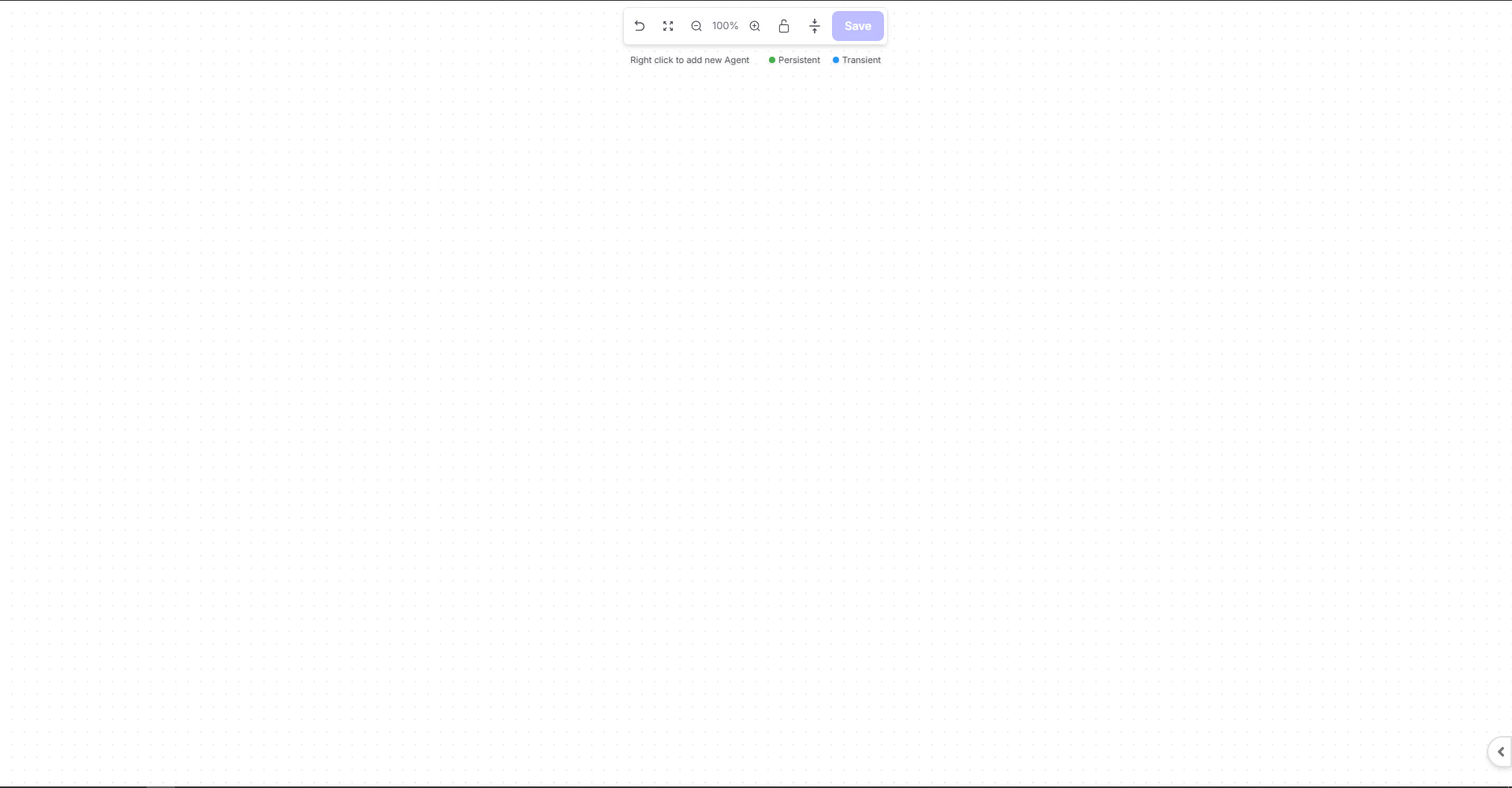
When you open the Studio, you’ll see an empty canvas where you can start adding and connecting agents.- Right-click anywhere on the canvas to add a new Agent node.
- Use drag-and-drop to connect agents with directional links.
- Color Codes:
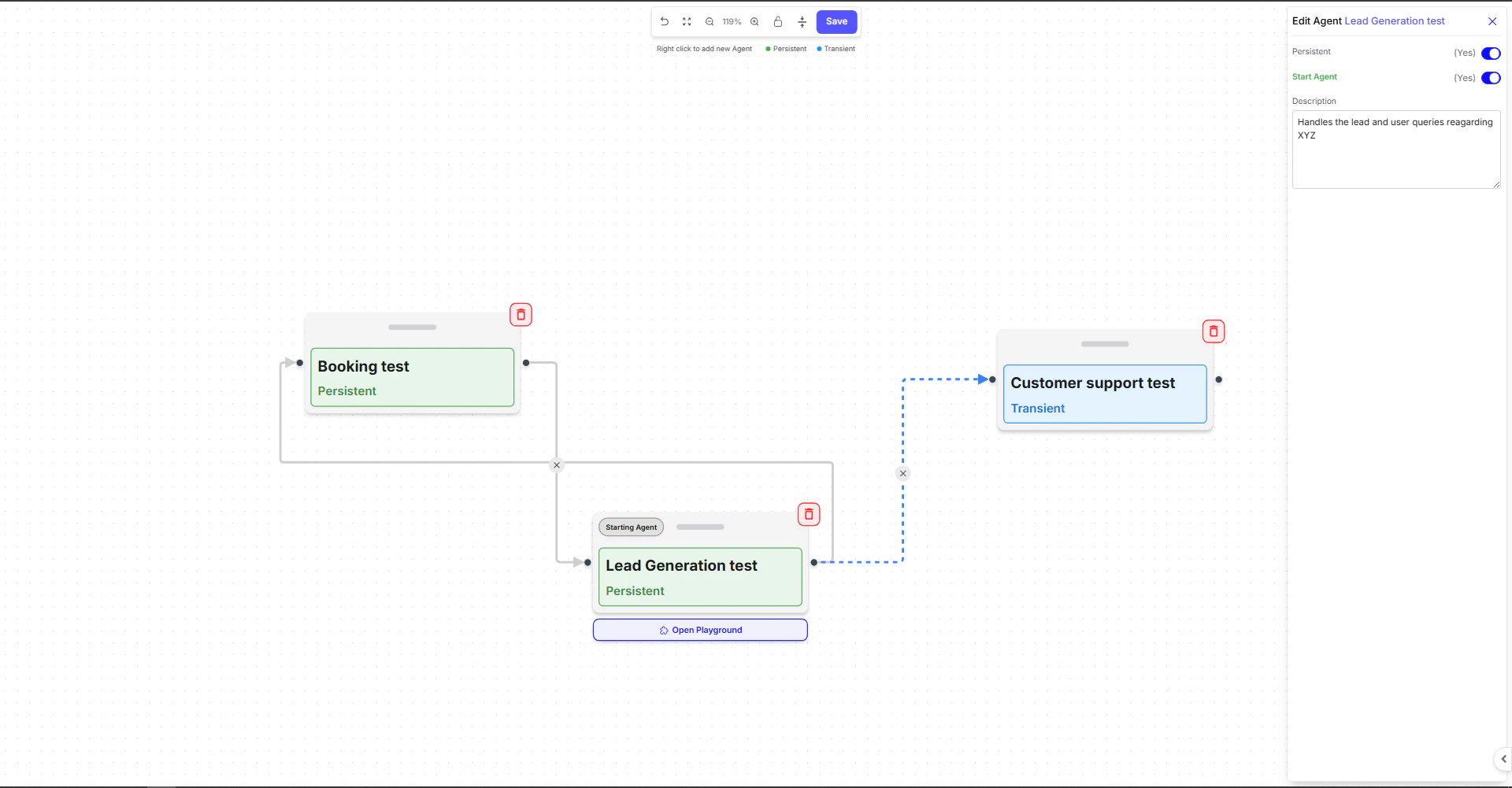
- 🟢 Persistent Agents – These are your root or main agents that maintain state, conversation history, and continuity across interactions.
- 🔵 Transient Agents – These are temporary agents that handle specific subtasks (e.g., customer support, scheduling). Once their task is done, control returns to the Persistent agent.
💡 Example:
In the layout below, “Lead Generation Test” is the starting Persistent agent, coordinating the flow. When customer queries move to booking or support, control is temporarily passed to Transient agents such as “Customer Support Test,” before returning back.
Key Features
Agent Nodes
Each node represents a Conversational AI Agent, and you can configure the following:- Description – A brief summary of the use cases that the specific AI agent is responsible for.
- Whether the agent is Persistent or Transient.
- Whether the agent is the Start Agent, which serves as the entry point for the workflow.
Right-Side Panel
When you select a node, a configuration panel appears on the right. You can:- Toggle Persistent and Start Agent settings
- Add a description or role definition
- Manage each agent’s context access and function scope
Connections
The arrows between agents define communication flow or handover direction. You can build:- Supervisor Models – One main agent oversees others.
- Network Models – Agents interact bidirectionally for shared tasks.
- Custom Models – Multi-level or domain-specific routing.
Save & Playground Preview
- Click Save to store your Squad configuration.
- Use Open Playground to test how agents collaborate in real time.
About conversation context
- When you have two or more persistent agents, they automatically share the conversation history, allowing each agent to maintain full context as the dialogue progresses.
- When a query is routed from a persistent agent to a transient agent, the conversation history is not shared.
- The transient agent receives only a clearly defined task, processes it, and returns the output without accessing or retaining the broader context.
- This ensures clean, focused task execution while keeping long-term conversational logic within the persistent agents.
Tips
- Use a Persistent root agent for overall control and memory retention.
- Assign Transient agents for specialized or temporary goals.
- Start with 2–3 agents, then expand your architecture as complexity grows.
Terminology Glossary
| Term | Description |
|---|---|
| Persistent Agent | The main/root agent that retains memory and state across the Squad. It acts as the central coordinator. |
| Transient Agent | A temporary agent that handles short-lived, specific tasks. After completing its work, control returns to the Persistent agent. |
| Start Agent | The entry point of your Squad — the agent that initiates all interactions or workflows. |
| Connection | A directional link that defines how agents pass control, share data, or communicate with each other. |